
Tag: science fiction
The Fractal Nature of Cartooning

I got the idea for this cartoon by stealing it. I try not to steal, at least this blatantly, but I was reading — not stealing — Paul Witcover’s post on the Inferior 4+1 blog — and I’ll confess that I was ready to be inspired, but no more than usual, just the default setting of any artist — when out of the blue, like a trap set for starving cartoonists who are always hungry for puns and punchlines — Paul Witcover described old papers as being damaged by Mandelbrot Mice.
He didn’t describe a situation that made me think of fanciful mice eating paper in an ever-reducing pattern. He did all the work of a cartoonist, short of drawing it. And I did all the work of a thief, short of selling it.*
Artists steal all the time. Not with the intent of plagiarism, but with the intent of connecting.
Punchlines lead to punchlines. Again and again, top to bottom to top.
*It ran at American Scientist Online, but gratis. If you’re reading this, Paul, you’re 30% is in the mail.
Do the Twist
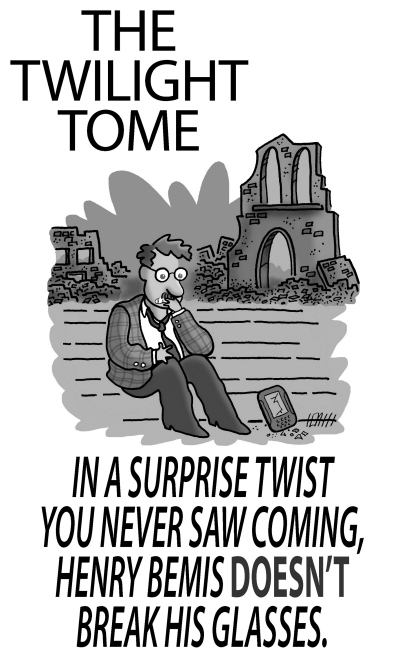
I need to draw the Twilight Tome title in the Twilight Zone manner — though I’ve watched enough episodes to know that the “classic” look wasn’t always used.
This is another in my series of fine caricatures that depend on my telling you who the subject is: Burgess Meredith, playing the clumsy misanthrope with the thick glasses.
Invisible Man, In Varying Degrees of Visibility
Being transparent, the Invisible Man would likely be blind. But more importantly, is it funnier to see the Invisible Man in full dress, or naked?
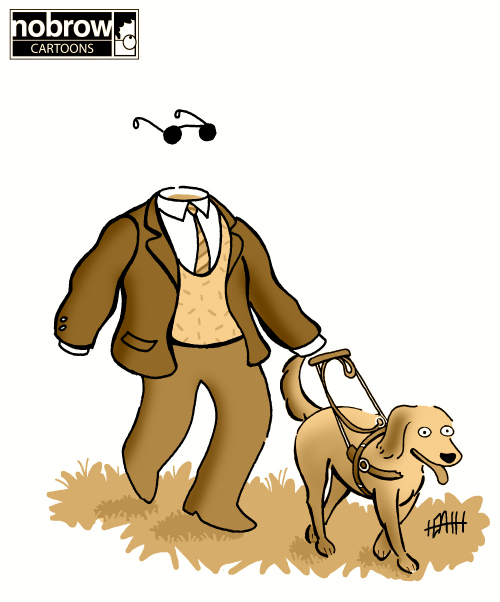
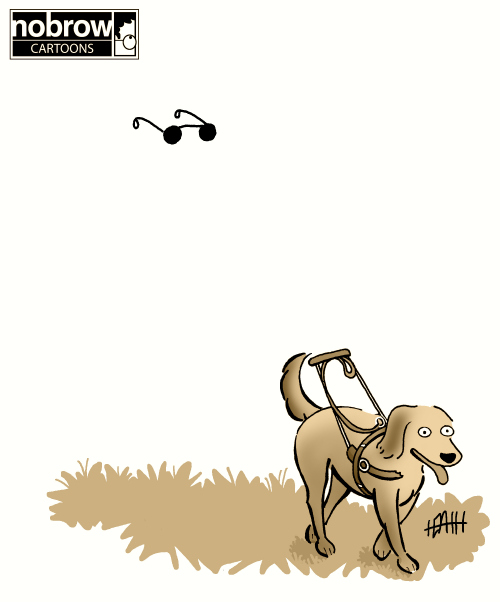
Are even the dark glasses too much? Would it be funnier with only the dog, and the caption, “The Invisible Man takes a walk.”
The Further Adventures of Mark in the Present in the Future
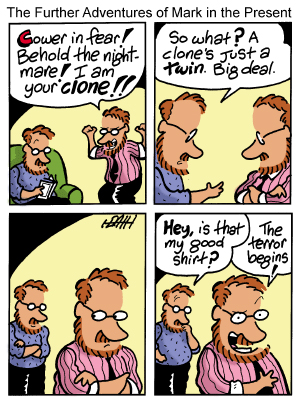
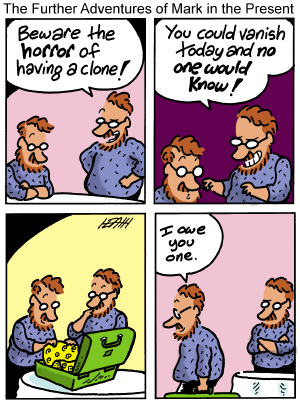
Years ago, I had a short-lived comic at Strange Horizons.
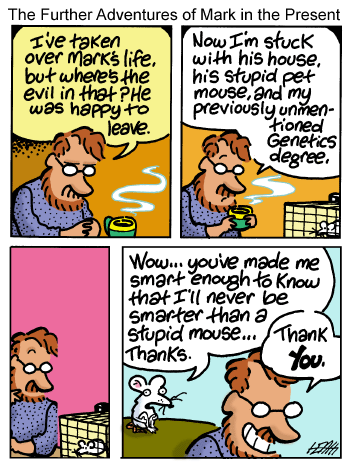
I liked it because it had my name in the title. Anonymity is the usual notice of a magazine cartoonist. Now I was eponymously anonymous.
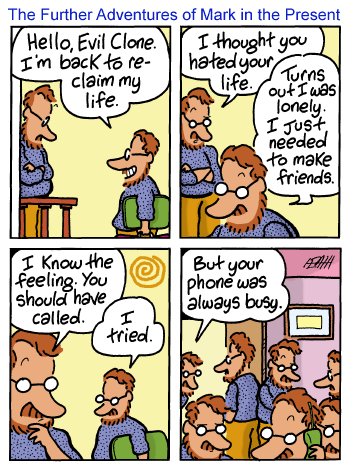
Now I’m wondering if there should be further further adventures.
Invisible Guy
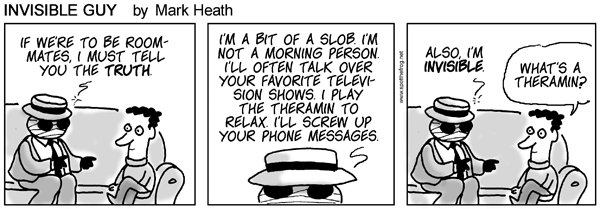
Not enough comic strips use theramin as a punchline.
The sound is often imitated — by a human voice, a computer, a bow drawn across the blade of a hand saw — but the theramin isn’t used, or even necessary. I’ll occasionally read the back story of a movie, tv show or pop song and discover that the wailing glissando was an uncanny imitation.* It’s as if the sound, once created, is free to roam the Earth like a shared mp3.
The slippery, operatic, chilling cry is the theramin’s ghost; a noisy spirit with a life long after the host is dead. Which is probably why it suited the score for Dark Shadows so well.**
*The Beach Boys’ “Good Vibrations,” for example.
**though, offhand, I don’t know if the sound was the ghost of a theramin, or the living instrument.
 Mark Heath cartoons